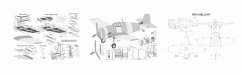

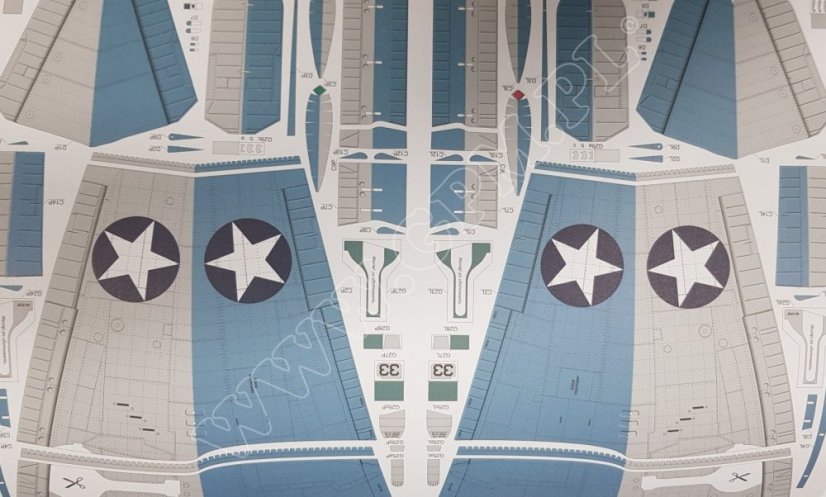
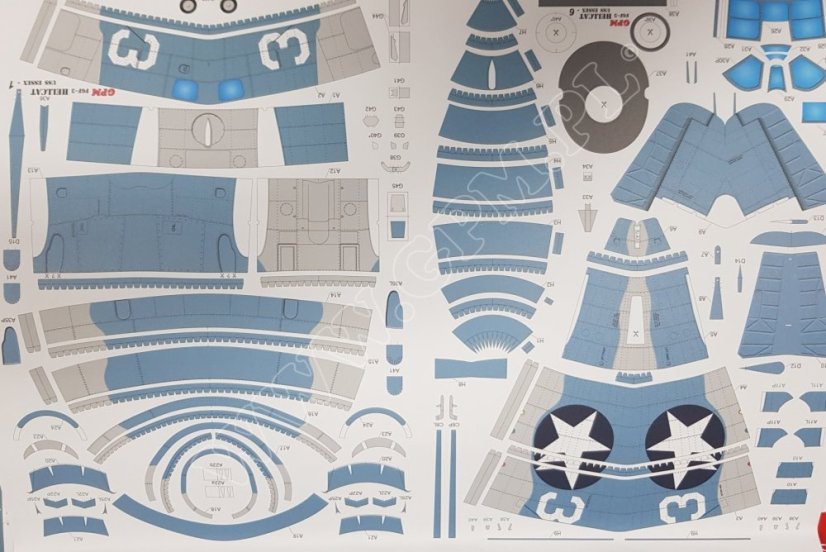
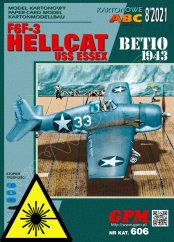
F6F-3 Hellcat Betio

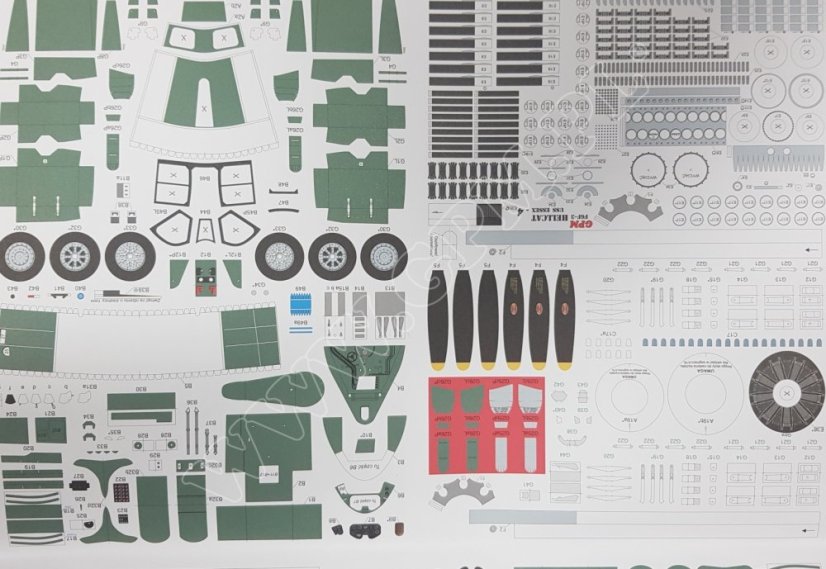


Related products3
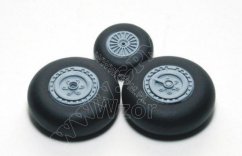
F6F-3 Hellcat Betio - plastic wheels
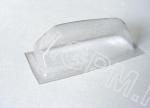
F6F-3 Hellcat Betio - cabin
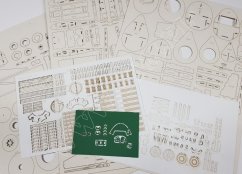
F6F-3 Hellcat Betio - Laser accessories - skeleton


You can find all parameters for the model on the side tab. We provide maximum information for each model so that you can make the right decision regarding your purchase.

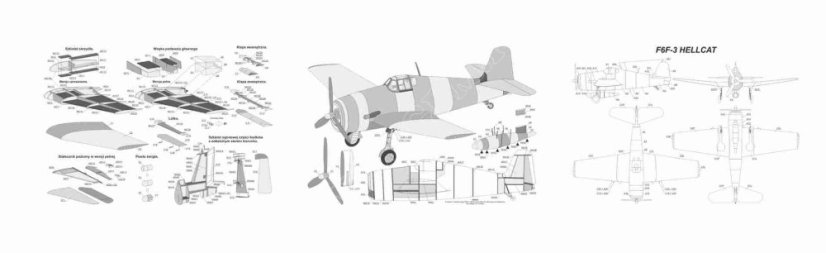
We also offer laser accessories for the paper model. These are parts of the frame, cabin, plastic wheels and details that will raise your model to a higher level and simplify your work.


The Grumman F6F Hellcat was an American airborne fighter aircraft designed in 1942 by Grumman based on its experience with the F4F Wildcat. She originally intended to innovate this machine, but ultimately decided on a completely new aircraft design.
The first prototype of the XF6F-1 machine took off on June 26, 1942. The machine was flown by pilot Sheldon A. Converse. The power of the Wright R-2600 engine proved to be insufficient, so it was replaced by the more powerful Pratt & Whitney R-2800. In the same year, serial production began, which took place on a mass scale, and in 1943 Hellcats began to be armed with American aircraft carriers. The machines were constantly improved, a version of a night fighter with radar or a reconnaissance version with a photographic device was also built. Some aircraft were converted to unmanned flying bombs (F6F-5K) during the Korean War. A total of 12,275 machines were produced.
the Grumman F6F Hellcats, together with the F4U Corsairs, gained a dominant position in air combat at sea. Hellcats were credited with 3/4 of all enemy aircraft kills in the Pacific (various sources give either 5155 or 5156 kills of Japanese aircraft), 305 aces flew it, and the most successful of them was David McCampbell, who with his "Minsi III" during 5 months as the US Navy's most successful fighter with 34 confirmed kills. Although the Hellcat was twice as heavy as the Zero, it made up for it with strong armament, robust construction, good passive protection for the pilot and tank, and finally sophisticated deployment tactics. Thanks to the Hellcats, the military situation in the Pacific was turned around. The Americans destroyed the Japanese machines on a large scale, the total loss ratio was 19.1÷1 in favor of the Hellcat pilots. One of the battles in the Pacific was even named "The Great Mariana Turkey Shoot". Due to the good experience, 1,100 machines were taken by the UK under a Lend-Lease agreement. They served on both aircraft carriers and land bases of the Royal Navy. After the Second World War, the planes were purchased by France, which used them in the battles over Indochina, Argentina and the Air Force of Uruguay, which only retired the Hellcats in 1961.
| Scale | 1:33 |
|---|---|
| Difficulty | 2/3 - Medium |
| Instructions | Graphic instructions, polish |
| Number of pages with parts | 8 |
| Page size | A4 (210 x 297 mm) |
| Printing method | Offset printing |
| Model type | Paper model |
| Země vydání | Polsko |
| Scale | 1:33 |
|---|---|
| Difficulty | 2/3 - Medium |
| Instructions | Graphic instructions, polish |
| Number of pages with parts | 8 |
| Page size | A4 (210 x 297 mm) |
| Printing method | Offset printing |
| Model type | Paper model |
| Země vydání | Polsko |